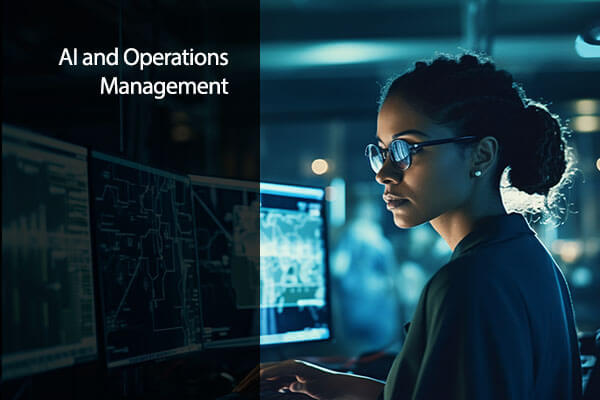
This curriculum is designed to transform operational professionals into AI-literate strategists capable of leading technological integration.
Core Learning Outcomes
Operational Foundations: Understand the intersection of traditional operations management and modern AI capabilities.
Supply Chain Mastery: Explore AI techniques for supply chain optimization, focusing on logistics, inventory management, and route planning.
Maintenance Strategy: Learn about predictive maintenance and how AI reduces downtime by anticipating equipment failure.
Forecasting Precision: Master demand forecasting methodologies, utilizing historical data and AI trends to predict market needs with high accuracy.
Quality & Workforce: Analyze AI applications in quality control automation and workforce management optimization.
Strategic Implementation: Identify emerging technologies and discuss the challenges, ethical considerations, and adoption strategies for AI in operations.
Target Audience
Operations Managers seeking to modernize their processes.
Supply Chain Professionals looking for data-driven optimization techniques.
Data Analysts aiming to apply their skills in an operational context.
IT Operations Specialists and individuals preparing for certifications like Certified Supply Chain Professional (CSCP).
Included in This Course
Enrolling in the AI and Operations Management program grants access to a comprehensive suite of learning resources:
In-Depth Video Lectures: Modules covering every aspect of AI integration in operations.
Hands-On Demonstrations: Practical guides on using Generative AI tools (ChatGPT, Google Gemini) for operational tasks.
Real-World Case Studies: Analysis of successful AI implementation in global supply chains and manufacturing.
Strategic Frameworks: Templates and guides for developing an AI security roadmap and governance framework.
Certification Preparation: Content aligned with the knowledge areas required for roles like AI and Machine Learning Specialist.
Certificate of Completion: A professional credential validating your expertise in AI-driven operations.
Operational Revolution: Integrating Artificial Intelligence for Maximum Efficiency
Mastering the Future with an AI and Operations Management Course
The global business landscape is undergoing a seismic shift. The traditional methods of managing operations—relying on historical spreadsheets, manual inventory checks, and reactive maintenance—are rapidly becoming obsolete. In their place, a new paradigm is emerging, driven by data, algorithms, and automation. The AI and Operations Management course stands at the forefront of this revolution, offering a pathway for professionals to bridge the gap between legacy processes and the future of artificial intelligence in operations.
Operational efficiency is the engine of any successful enterprise. However, as supply chains become more global and consumer demands become more volatile, human intuition alone is insufficient to manage the complexity. This article explores how AI and operations management training empowers leaders to harness the predictive and analytical power of AI, transforming challenges into competitive advantages.
The Intersection of AI and Operational Strategy
Operations management has always been about making the best use of resources. AI supercharges this objective. It does not replace the operations manager; rather, it augments their capabilities, providing "bionic" insight into processes that were previously opaque.
By integrating AI technologies, organizations can process vast amounts of unstructured data—from weather patterns affecting shipping routes to social media trends influencing demand. This course demystifies these technologies, moving beyond the hype to focus on practical applications. We examine how machine learning models identify patterns in operational data that human analysts might miss, leading to smarter, faster decisions.
Revolutionizing the Supply Chain
The supply chain is perhaps the area most visibly impacted by AI. A significant portion of this curriculum is dedicated to supply chain optimization. Traditional supply chain management involves a linear flow of goods and information. AI transforms this into a dynamic, interconnected digital network.
Through AI and Operations Management studies, professionals learn how to implement algorithms that optimize logistics in real-time. Consider a scenario where a shipment is delayed due to a port strike. An AI-driven system can instantly recalculate routes, adjust inventory orders from alternative suppliers, and notify downstream distributors—all within seconds. This level of agility is impossible with manual management. The course covers AI techniques for supply chain optimization, ensuring learners can deploy these adaptive strategies to minimize costs and maximize service levels.
The Power of Predictive Maintenance
Downtime is the enemy of productivity. In manufacturing and logistics, a single machine failure can halt an entire production line, costing thousands of dollars per minute. The transition from preventive maintenance (servicing machines on a schedule) to predictive maintenance is a game-changer.
This course delves into how AI utilizes data from Internet of Things (IoT) sensors to monitor the "health" of equipment. By analyzing vibration, temperature, and acoustic data, AI models can predict when a component is about to fail before it happens. This allows maintenance to be scheduled during non-productive hours, preventing unplanned outages. Learning the benefits of AI in maintenance planning is essential for any IT Operations Specialist or Operations Manager tasked with asset management.
Precision in Demand Forecasting
"What will our customers want next month?" This is the multi-million dollar question. Traditional forecasting methods often rely on simple year-over-year comparisons. Demand forecasting methodologies enhanced by AI take a multidimensional approach.
In this AI and Operations Management Course, students explore how to leverage AI to analyze diverse data sets—economic indicators, competitor pricing, and even local events. This results in forecasts with significantly higher accuracy. By mastering demand forecasting, businesses can reduce the capital tied up in excess inventory while ensuring they have enough stock to meet surges in demand. We explore the future of AI in this area, including the use of Generative AI to simulate market scenarios.
Elevating Quality Control
Quality control has traditionally been a labor-intensive process, subject to human error and fatigue. AI, specifically Computer Vision, brings a level of consistency and precision that is unmatched.
The curriculum analyzes AI applications in quality control, showing how cameras linked to AI processors can inspect products on a conveyor belt at high speeds. These systems can detect microscopic defects—scratches, misalignments, or color variances—that the human eye would miss. For the Quality Control Manager, understanding how to implement and train these systems is now a requisite skill. It ensures that only flawless products reach the customer, protecting the brand reputation and reducing returns.
Workforce Management and Generative AI
Operations is not just about machines; it is about people. Workforce management is another critical domain where AI is making strides. From optimizing shift schedules based on predicted foot traffic to matching employee skills with specific tasks, AI ensures that human resources are utilized effectively.
Furthermore, the course introduces hands-on experiences with Generative AI tools like ChatGPT and Google Gemini. These tools are revolutionizing administrative operations. Learners will see how to use these platforms to generate operational reports, draft safety protocols, or analyze complex process documentation in seconds. This practical exposure ensures that students are not just learning theory but are ready to use the tools of the trade.
Navigating Implementation Challenges
Adopting AI is not without its hurdles. The course provides a balanced view, discussing the challenges and considerations in AI adoption. This includes data privacy concerns, the need for robust IT infrastructure, and the cultural resistance often faced when introducing automation.
We discuss the role of the Data Analyst and Supply Chain Analyst in bridging the gap between technical teams and operational leadership. Understanding how to manage the "change management" aspect of AI adoption is crucial for long-term success.
Career Impact and Certification
The demand for professionals who understand both operations and AI is skyrocketing. Roles such as AI and Machine Learning Specialist, Supply Chain Analyst, and Operations Manager are increasingly requiring AI literacy.
Completing this course provides a strong foundation for those preparing for certifications like the Certified Supply Chain Professional (CSCP). It signals to employers that you possess a forward-thinking skillset. Whether you are looking to optimize a warehouse, streamline a procurement process, or lead a digital transformation initiative, the knowledge gained here is your toolkit for success.
Conclusion: The Operational Edge
The integration of AI into operations is not a trend; it is the new standard. Those who ignore it risk falling behind, while those who embrace it gain a significant competitive edge. AI and Operations Management offers the comprehensive training needed to navigate this transition.
By combining theoretical insights with practical application, this course prepares you to be an architect of efficiency. From supply chain optimization to predictive maintenance, the opportunities to add value are limitless. Enroll today to begin your journey into the future of operations, and equip yourself with the skills to lead your organization into a smarter, more efficient tomorrow.
Frequently Asked Questions (FAQ)
1. Do I need technical programming skills to take this course?
No, advanced programming skills are not required. While the course covers technical concepts regarding AI applications, the focus is on the strategic and operational implementation of these technologies. Hands-on demonstrations with tools like ChatGPT and Google Gemini are designed to be user-friendly for non-programmers.
2. How does this course help with Supply Chain Management?
The course dedicates specific modules to supply chain optimization. You will learn how AI is used for route planning, inventory forecasting, and supplier risk management, providing you with actionable strategies to improve logistics efficiency.
3. What specific tools will I use in this course?
You will engage with Generative AI tools such as ChatGPT and Google Gemini. The course demonstrates how to leverage these platforms for operational tasks like report generation, process analysis, and decision support.
4. Is this course suitable for IT professionals?
Yes. It is highly beneficial for IT Operations Specialists and data professionals who want to apply their technical skills in a business context. It bridges the gap between IT capabilities and operational requirements like predictive maintenance and quality control.
5. Will I learn about Predictive Maintenance?
Yes, predictive maintenance is a key topic. The course explains how AI analyzes data from IoT sensors to predict equipment failures, allowing for proactive maintenance that reduces downtime and costs.
6. Can this course help me get certified?
While this is a standalone training course, the content aligns with knowledge areas found in major certifications such as the Certified Supply Chain Professional (CSCP). It provides the foundational knowledge necessary for these exams and for roles like AI and Machine Learning Specialist.
7. What job roles is this course designed for?
The course targets a wide range of professionals, including Operations Managers, Supply Chain Analysts, Quality Control Managers, Data Analysts, and anyone responsible for enhancing operational efficiency within an organization.
.jpg "Horizons 600 X 400 Px 1764089009 Dwcpw (1)")